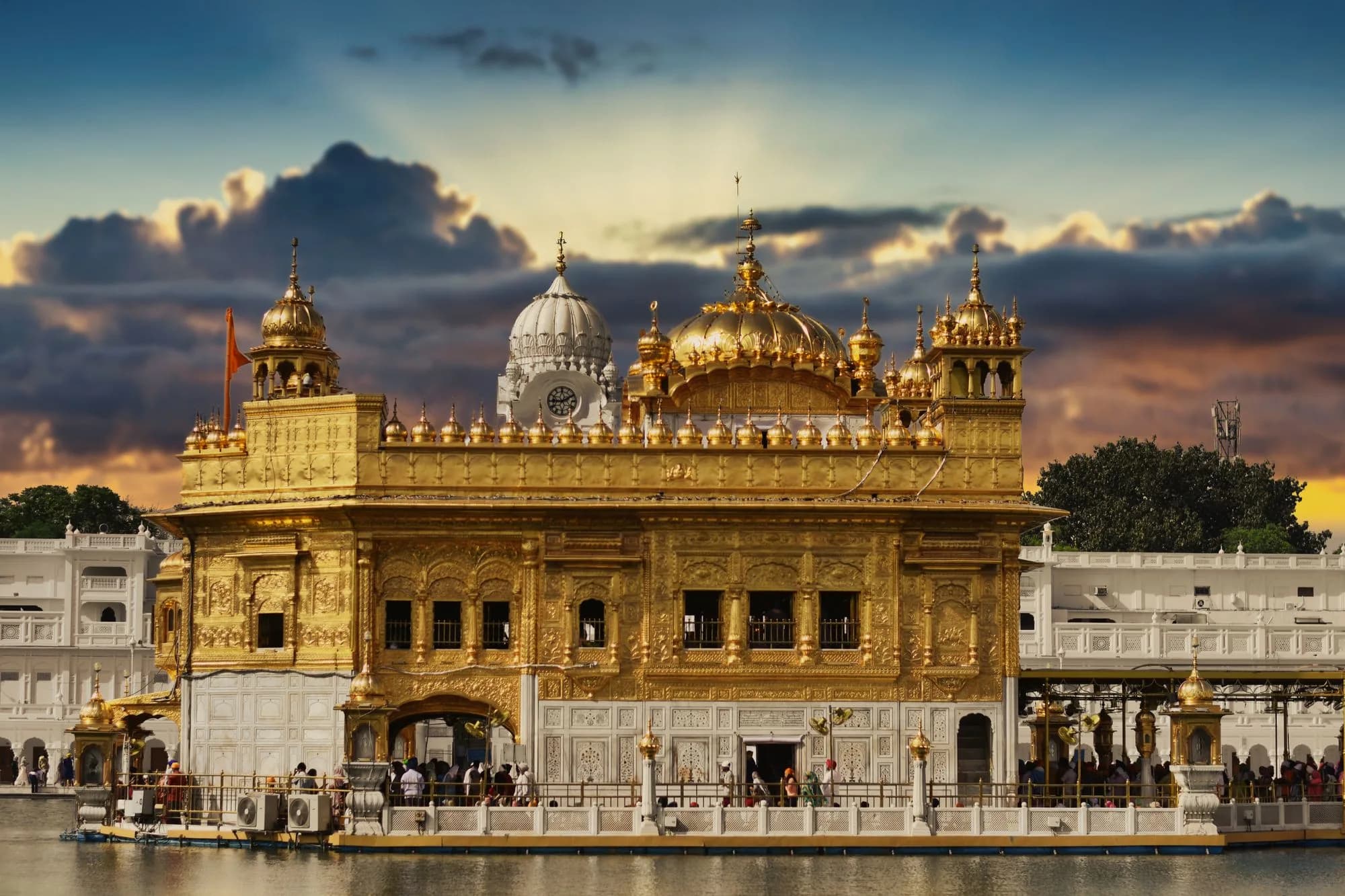
Amritsar, Punjab, India
Wedding photography in Amritsar
In short
Aavira Films is a wedding photography and cinematography studio available for weddings in Amritsar. Here that usually means a choora before sunrise at a house in the old city, an Anand Karaj at a neighbourhood gurdwara before noon, langar, a doli in hard afternoon light and a reception out on the bypass — covered as a photo story and as a film. It suits couples who want the day documented as it happens, inside gurdwara etiquette rather than around it.
- Region
- Majha
- Ceremony
- Anand Karaj, morning, usually 8–11am
- Airport
- Amritsar (ATQ), about 11km from the city
- Busiest weeks
- Mid-December to mid-January
On the ground
How weddings run here
Coverage
What we photograph and film in Amritsar
Photography, cinematography, pre-wedding and destination coverage — each with the local detail that changes how it is planned.
- Anand Karaj coverage
- Choora and maiyan at home
- Jaggo and sangeet
- Milni and baraat
- Doli and vidaai
- Wedding photography
- Cinematic wedding films
- Reception coverage
- Pre-wedding portraits
Wedding photography in Amritsar
Three lighting problems in six hours: a dark old-city room at dawn, a flat marble darbar with no flash, and a doli under hard afternoon sun. Coverage is planned around those, and around the fact that the wedding is over by lunch.
See the photography workWedding cinematography in Amritsar
The film is built on the audio — the lavaan and kirtan in the darbar, the boliyan at jaggo, what gets said at the doli gate. Recording that inside a gurdwara means no rigs, no elevated positions and no flash, working from the floor with the sangat.
Open the film libraryPre-wedding shoots in Amritsar
The walled city's lanes and gates, Gobindgarh Fort, the countryside towards Ajnala, and mustard fields in February. Public and heritage sites generally need permission for a shoot, and the quiet, workable hours are the first and last of the day.
How pre-wedding shoots workDestination and NRI weddings in Amritsar
A December wedding in Amritsar is usually a destination wedding for half the guest list. Less time on the ground, more relatives who have flown a long way to be in the frames, and a real case for delivering a first edit while everyone is still in the country.
Destination wedding coverageVenues
Where weddings happen in Amritsar
The kinds of places a wedding here actually takes place, and what each one asks of a photography and film team.
Neighbourhood gurdwaras
Where the Anand Karaj actually happens for most Amritsar families — a local gurdwara close to the house rather than a landmark. Bright, marble-lined, flat-lit halls, no flash, floor-level working positions only, and a committee whose permission is worth having in writing beforehand.
Marriage palaces on the bypass
The Amritsar–Batala, Ajnala and Jalandhar roads carry most of the city's palace venues: lawn for the baraat, a large hall lit entirely with coloured artificial light, rooms upstairs. Easy access for guests driving in from the districts, and a hall that needs balancing before the baraat arrives.
Hotels around Ranjit Avenue and Airport Road
The city's modern hotel belt, used for receptions and for housing guests who have flown in. Reliable power and air conditioning, controllable banquet lighting, and short transfers to the airport.
Heritage-styled properties near the walled city
Smaller properties within reach of Harmandir Sahib, often used for the family stay and for a compact reception. Character in the architecture, tight space for movement and lighting.
Old-city family homes
The choora, maiyan, sehra bandi and doli happen here. Expect a room with one window, a courtyard well below the skyline, a staircase everyone has to pass through, and the most emotionally loaded frames of the wedding.
Farm and lawn venues towards Ajnala and Batala
Open ground outside the city, good afternoon light, room for a full baraat, and a long unlit walk between lawn and hall once the sun drops.
Logistics
Getting there, and getting around
FAQ
Planning a wedding in Amritsar
The things worth settling before you book anyone to photograph a wedding here.
What time does an Anand Karaj in Amritsar usually start?
Almost always in the morning — commonly between 8am and 11am — because the ceremony takes place in the presence of the Guru Granth Sahib during the morning diwan. That fixes the rest of the day backwards: choora before sunrise, maiyan after it, milni immediately before the ceremony, langar after, doli in the early afternoon. A team should be inside and settled around 45 minutes before the ceremony begins, which in December means arriving in the dark.Can we have our wedding photographed at the Golden Temple?
Harmandir Sahib is a working place of worship with very heavy footfall, and photography inside is governed by the managing committee and by the conduct rules that apply to every visitor — it is not a location where a crew sets up lights, stands or a drone. Many couples go for matha tekna and are photographed the way any visitor may be. If that matters to you, go pre-dawn or after dark when the parikrama is quietest and the building is lit, allow far more time than seems necessary, and ask the committee rather than assuming.When should we book photography for a December wedding in Amritsar?
Earlier than you think. Mid-December to mid-January is the busiest wedding window in the city because that is when families based in Canada, the UK, the US and Australia are able to travel. Venues, decorators and photography teams commit for those weeks well ahead of the season. For a date in that window, start the conversation the moment the date is fixed rather than a few months out.Is a drone allowed at an Amritsar wedding?
Sometimes, and never automatically. Amritsar is close to the international border and much of the city sits under controlled airspace around Sri Guru Ram Das Jee International Airport. Any flight has to be checked against the current DGCA airspace map and carry the applicable authorisation — a venue giving permission does not make the airspace legal. Nothing flies inside or above a gurdwara darbar under any circumstances.Our home is in the old city and the gurdwara is elsewhere. Do we need two teams?
Usually yes, at least for the wedding morning. Movement through the katras at wedding hour is slow and unpredictable, and the choora, maiyan and sehra bandi overlap with the baraat gathering somewhere else entirely. Splitting means one unit stays with the bride from the earliest ceremony through the doli while another is already at the gurdwara and later at the reception venue, testing the hall before anyone walks into it.What does the winter fog do to the photographs?
It makes them softer and quieter — even, directionless light that suits portraits, doli frames and anything with emotion in it, at the cost of wide venue shots and long-lens compression. The bigger issue is logistics: from late December into January fog delays flights into Amritsar and slows the roads out to the bypass venues, so the crew, and ideally the family, should be in the city the night before rather than travelling in on the morning.