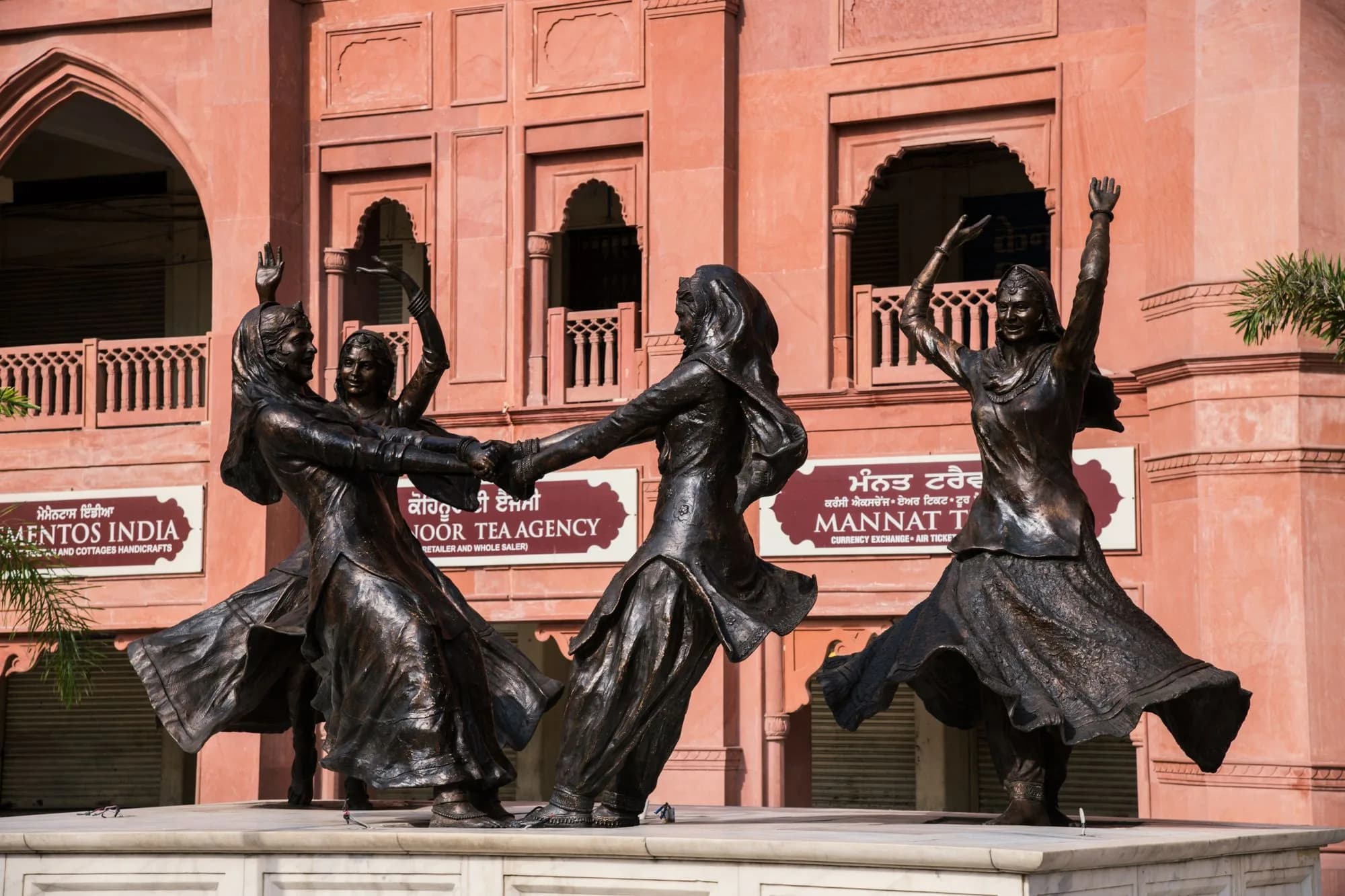
Firozpur, Punjab, India
Wedding photography in Firozpur
In short
Aavira Films is a wedding photography and cinematography studio available for weddings in Firozpur. This is a border and cantonment district, so a wedding here comes with real constraints on drones, on where a crew may work and on how close to the frontier anyone can shoot — alongside a straightforward Malwa wedding of choora, morning Anand Karaj, doli and reception. It suits couples who want those constraints handled properly rather than discovered on the day.
- Region
- Malwa, on the international border
- Ceremony
- Anand Karaj, morning, usually 8–11am
- Arrivals
- Firozpur by rail; Amritsar (ATQ) about 120km
- Note
- Drones restricted; cantonment access needs advance clearance
On the ground
How weddings run here
Coverage
What we photograph and film in Firozpur
Photography, cinematography, pre-wedding and destination coverage — each with the local detail that changes how it is planned.
- Anand Karaj coverage
- Cantonment and service weddings
- Village home ceremonies
- Choora and maiyan
- Doli and vidaai
- Wedding photography
- Cinematic wedding films
- Reception coverage
- Pre-wedding portraits
Wedding photography in Firozpur
A straightforward Malwa wedding inside a district with real access rules. The work is on the ground — the courtyard, the darbar, the doli gate — and the constraints are settled before the day, not at it.
See the photography workWedding cinematography in Firozpur
No aerials to lean on here, which is no loss: the film is built from the lavaan, the boliyan and what gets said when the bride leaves. That is where a wedding film has always come from.
Open the film libraryPre-wedding shoots in Firozpur
The Sutlej and the canal network give this district more water and more trees than most of Malwa. Locations are chosen well away from the border area, where photography is restricted.
How pre-wedding shoots workDestination weddings in Firozpur
Two and a half hours from the nearest useful airport and a long way from most guests, so the crew and out-of-town family arrive the day before as a matter of course.
Destination wedding coverageVenues
Where weddings happen in Firozpur
The kinds of places a wedding here actually takes place, and what each one asks of a photography and film team.
Cantonment premises
Used by the district's many service families. Access, timings, guest and crew lists and photography permissions follow the establishment's rules, arranged weeks ahead. Drones should be assumed prohibited.
Marriage palaces on the Moga and Fazilka roads
The standard reception venue: lawn for the baraat, a large hall lit entirely with coloured artificial light, rooms and parking, placed on the highway for guests arriving from across the district.
Village gurdwaras and town gurdwaras
Where the Anand Karaj takes place. Plain, flat-lit halls, no flash, floor-level positions only, and permission arranged with the granthi or committee a few days ahead.
Village family homes
Choora, maiyan, sehra bandi and the doli. Courtyards, roofs and small rooms, with the whole village passing through the gate at some point in the morning.
Memorials and public sites
The Hussainiwala National Martyrs Memorial and the Saragarhi memorial are public sites of national significance near or in the town. They are places of commemoration with their own rules and, near the border, with security restrictions — not backdrops.
Farm and canal-side ground
The Sutlej and the canal network give this district more trees and water than most of Malwa, which makes it better for portraits — subject to keeping well away from the border area.
Logistics
Getting there, and getting around
FAQ
Planning a wedding in Firozpur
The things worth settling before you book anyone to photograph a wedding here.
Can we have drone footage at a Firozpur wedding?
Assume not, unless it has been explicitly cleared in advance. Firozpur is a border district with defence installations, and airspace near an international border and near military sites is restricted. A flight has to be checked against the current DGCA airspace map for the specific venue and carry the applicable authorisation — and a venue giving permission is not an airspace clearance. A photography team that quotes drone coverage here without having settled that first is quoting something it may not be able to deliver.Our reception is on cantonment premises. What has to be arranged?
Passes and identity details for the crew alongside the guest list, submitted well in advance; agreement on which parts of the premises may be photographed; the establishment's timings, which are fixed; and an assumption that a drone will be refused. None of this is difficult when it is handled a few weeks ahead. All of it is a serious problem when it is raised at the gate on the morning of the wedding.Can we do a shoot near Hussainiwala or the border?
The area needs care and it is not a backdrop. Hussainiwala holds the National Martyrs Memorial where Bhagat Singh, Rajguru and Sukhdev were cremated — a place of commemoration with its own conduct expectations — and it sits close to the frontier, where photography near the border fence and military installations is restricted and access can require identification and clearance. For portraits, the canal and river country away from the border gives you the same landscape without the constraints.How do guests reach Firozpur?
Mostly by train — Firozpur is a divisional railway headquarters with good connections through Ludhiana, Jalandhar and Bathinda. There is no useful airport in the district: Amritsar is roughly 120km and about two and a half hours, Ludhiana around 130km, Bathinda about 110km and Chandigarh roughly 250km. Anyone flying in should arrive the day before, particularly between late December and January when fog slows every road out of the airport.Does the border location change how the wedding itself is covered?
Only at the edges. The ceremonies, the home rituals and the reception are covered exactly as they would be anywhere in Malwa — the restrictions are about airspace, about proximity to the frontier and about cantonment access, not about the wedding. What it does change is the planning conversation: those three things need answering before the quotation is agreed, so that nobody is promising aerials or a memorial-side portrait session that cannot legally happen.